
Why I Do What I Do. Being Seen: Purpose, Personhood and Dementia Care
Mike’s Monthly Thoughts and Reflections
The meaning of life is to find your gift.
David Viscott
The purpose of life is to give it away.
I’m often asked, “Why do you do what you do?” In this month’s Pause for Thought, I share some personal insights into why I’m passionate about what I do.
A Sense of Purpose
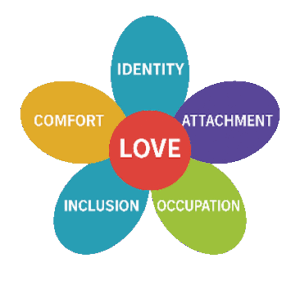
A simple answer to the question comes from Tom Kitwood’s flower of psychological needs – which, although developed for people with dementia, I believe applies to all of us. One of those petals is occupation.
This is often misunderstood as job or career. But Kitwood meant something deeper: a sense of purpose, meaning and fulfilment. A reason to get up in the morning. A feeling that you matter.
Like any organisation, I have a mission – releasing potential through learning and development. I believe that everyone who comes on one of my courses already has helpful attitudes, skills and knowledge. My role is not to “give” these things, but to help people see and develop what’s already there – so they can better serve their charity’s beneficiaries, or, increasingly in my work, improve the quality of life of people living with dementia.
And yes, I’ll admit it – I get a real buzz when someone has a lightbulb moment. When a learner suddenly understands why someone might be asking to go home to their mum. Or when they recognise something new about themselves and how they work with others. In those moments, it feels like my purpose has been lived out.
Recently, I’ve been delivering my Magical Presentations course to Experts by Experience – in this instance, carers sharing their own stories. When they realise that the “magic trick” isn’t magic at all, just something you can learn, my job feels done. One carer stood up, overcame a deep fear of public speaking, and spoke to a room full of warmth and applause.
Afterwards, they said, “I never dreamed I could do that.” That day, my sense of purpose was complete.
Where it Began
But the reason I do what I do runs much deeper than training rooms and lightbulb moments. It is rooted in who I am and the values I carry with me.
When I was born, my grandmother was the Matron of what was then called an “old people’s home” – The Court, a former mansion house. I spent much of my childhood there, and at one point lived there full-time when my father attempted suicide and my parents’ marriage nearly ended.
After breakfast, I would wander into the residents’ lounge and “entertain” people by singing songs from Sunday School, complete with actions. I sometimes joke with friends at NAPA that I was probably the UK’s youngest activity provider.
People I will Never Forget
Even now, I can picture the residents vividly. May Richards, who wore callipers on both legs. Mr Nurton, a World War I veteran with a lump on his head that frightened me slightly as a child – a shrapnel wound, I later realised.
Mrs Schoefield was a character. Each day she would send me – with a care worker escort to cross the busy road – to buy her apples and Nuttall’s Mintoes. She’d then bound up the grand staircase to fetch the coins. Risk assessments weren’t what they are now; nobody seemed to fear that she might fall. She lived to be 100.
Mrs Schoefield had once played piano for silent films in Cardiff’s main cinema. She shared wonderful stories during “grown‑up conversations” with my mother. How I wish I’d had the chance, as an adult, to hear those stories fully.
But one specific memory explains why I do what I do.
Mrs Cellophane
The Court had a vast lobby, with wooden benches like those scattered around its extensive grounds. One hot day – I think it was the heatwave of 1976 – I ran inside from playing and saw a woman sitting alone on one of those benches. She was surrounded by suitcases.
I’ll call her Mrs Cellophane, because I never knew her name – and it was as if people could see right through her.
Confused, I asked Aunty Pat, the cook. She quietly told me that Mrs Cellophane was being sent to “Ely” and that we mustn’t talk about it. Mrs Cellophane never came back.
Years later, when I moved to Cardiff as an adult, I realised the truth. Ely Hospital was the local asylum. Mrs Cellophane had likely been living with dementia.
I know what asylums were like in those days. After my father attempted suicide, he was sent to one. I visited him. These were places people were sent to be hidden away and forgotten.
Why This Still Matters
Things have changed – but not enough.
There are still places where dignity is compromised. Where person‑centred care is discussed but not lived. Where people become invisible.
That’s why I do what I do.
I believe we all carry reasons – sometimes unspoken – for the work we choose. Whenever I deliver dementia training, I am humbled by the kindness, dedication and humanity of care workers, activity providers, occupational therapists, nurses, gardeners, housekeepers, team leaders and so many others.
Working with David Sheard deepened my understanding of the importance of recognising our own vulnerabilities, so we can truly empathise and practise person‑centred care.
Final Thoughts – Shared Humanity
Kitwood’s flower is not just about people with dementia. It’s about all of us. We share the same psychological needs, the same desire to be seen, valued and connected.
That shared humanity is why this work matters – and why I do what I do. So, why do you do what you do?
I’ll close with the words with which I open every dementia course that I deliver:
I’ve learned that people will forget what you said, people will forget what you did, but people will never forget how you made them feel.
Maya Angelou
Over to you to Release Your Potential
Consider:
Stay Connected
If you would like training or coaching or consultancy that would help your organisation with these issues, I offer a broad range of courses.
Visit my website and book a Discovery Call and explore your learning and development needs. It’s a friendly, no-pressure conversation focussed on your goals, challenges and the outcomes you want to achieve.
This is great! Look forward to putting so much of this into practice. Thanks Mike.