
Belonging Begins with Being Seen
Identity, Inclusion and the Need to Belong
Mike’s Monthly Thoughts and Reflections
My identity might begin with the fact of my race, but it didn’t, couldn’t end there.
Barack Obama

Earlier this month I returned to Wales to visit my dear friend Cath, whom I have known for more than 40 years. Alongside seeing Miss Saigon, I took the opportunity to catch up with friends from the charity I co-founded and from the Royal Welsh College of Music and Drama, where I trained as an actor many years ago.
It got me thinking about who we are and how each of us is made up of many pieces that together create the person we become.
It’s also Pride Month and, like many, I watched Russell T Davies’ harrowing drama ‘Tip Toe’ on Channel 4. Spoiler alert, the central character is brutally lynched and murdered by a homophobic mob led by his neighbour – all because of his identity.
If you read last month’s Pause for Thought, I looked back to my own experience of ‘queer bashing’ many years ago. Despite many positive changes, the drama highlights how hatred based on identity persists, whether because of sexuality, race, religion or other perceived differences.
Some online commentators questioned whether the events portrayed in the drama could still happen today, suggesting that society has become more accepting of LGBT+ people.
However, those of us who are LGBT+ know that this is far from the truth. We live in an era where hatred based on ‘othering’ and aimed at those who are different is increasingly on the rise.
Who Do You See? See Me
This is the title of a course I’ve recently been delivering about life story work with people with dementia. The course explores how we need to look behind the label of dementia, to see the whole person, including their life history and identity.
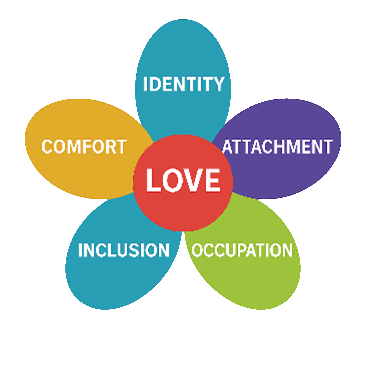
Tom Kitwood’s seminal work on dementia, and his flower metaphor, remain as relevant today as when they were first introduced. Identity is one of the petals of that flower.
Think about meeting someone for the first time. One of the first questions we often ask is: “What do you do?”
I often reply that I’m a trainer, consultant, facilitator and coach. But that is only one part of who I am.
Identity is multi-faceted. I am Welsh, a husband, a dog owner (three!), a Londoner, a former actor and a trainer. I love theatre, literature, travel, gardening and spending time with friends. Each of these forms part of who I am.
I am not one label or single identity, and neither are people with dementia.
Gwen and the Donkey Braying
A while back, I was delivering dementia training in the cinema room of a care home. A resident kept coming in and talking to the learner group, so I invited her to sit at the front with me. I somehow had a feeling that this woman wanted some attention and discovered she was a former actress.
At one point, I was explaining how auditory memory can be triggered by music and sounds and used a few sound effects to demonstrate this. I accidentally played the sound of a donkey braying, to which Gwen said: “The donkey used to come to the gate when I was young – it doesn’t any more.”
When I played the sound effect of a steam train leaving a station, Gwen declared: “When Daddy was away at the war, Mummy would take us on the train to the seaside to cheer us up.”
In moments, we learnt more about Gwen than any care plan could ever tell us.
We were able to look beyond the label of dementia and glimpse some of the many pieces that made Gwen who she was and still is.
In that moment, Gwen reminded us that identity, inclusion and belonging are deeply connected.
Why this matters now
Care plans are important, but they can only tell part of the story. They often focus on medication, health needs and support requirements. They cannot show us the whole person behind the diagnosis.
That’s why life story work is vital and should focus on the whole person, their past, their present and their hopes and dreams for the future. Person-led and person-centred care needs to start with the person and their multi-faceted identity. To focus on just one aspect of an individual’s identity means we are ignoring so much more.
Final reflections
Perhaps person-centred care does not begin with an assessment, a diagnosis, or even a care plan. Perhaps it begins with curiosity. A willingness to look beyond the label, beyond our assumptions, and beyond the stories we think we already know.
Every person we meet carries a unique combination of experiences, relationships, values, memories, hopes and dreams. When we take the time to discover who someone is, rather than simply what they are, we create the conditions for genuine inclusion, meaningful connection and true belonging.
After all, before people can belong, they need to be seen. Before they can be seen, they need to be known. And before they can be known, we must take the time to look beyond the label and discover the person.
Perhaps our greatest responsibility is to remain curious: to look beyond labels, listen to people’s stories and create places where everyone feels seen, valued and able to belong.
Perhaps belonging begins when we stop asking, “What’s wrong with this person?” and start asking, “Who is this person?”
True belonging doesn’t require us to change who we are. It requires us to be who we are.
Brené Brown
Over to you to Release Your Potential
Consider:
Stay Connected
If you would like training or coaching or consultancy that would help your organisation with these issues, I offer a broad range of courses.
Book a Discovery Call and explore your learning and development needs. It’s a friendly, no-pressure conversation focussed on your goals, challenges and the outcomes you want to achieve.
This is great! Look forward to putting so much of this into practice. Thanks Mike.